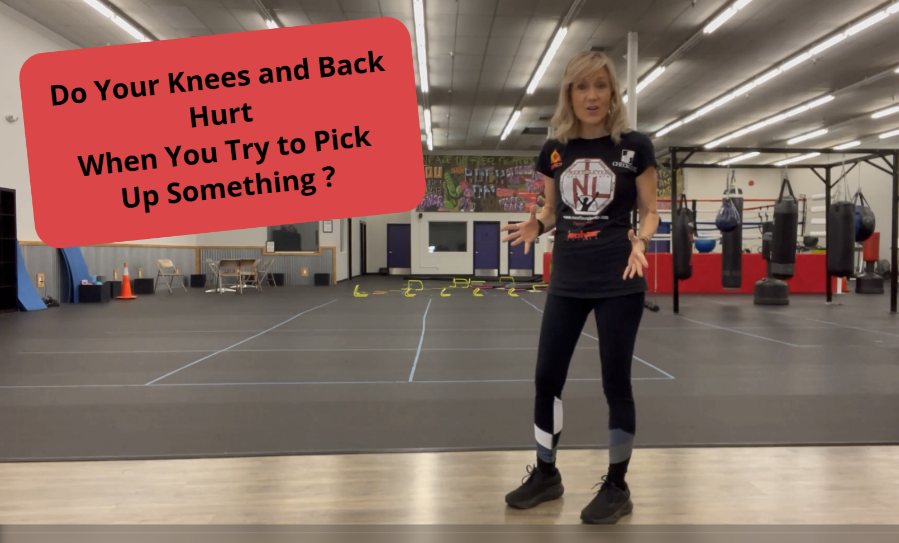
Rounded posture and a tucked pelvis often result from Parkinson’s disease. When bending down to pick up something from the floor, people will often bend their knees first, causing pain in their knees and back. This knee pain makes people avoid bending down or doing squats—which is the exact thing we should be doing to help our knees and back. But first, we must relearn how to hinge correctly.
Proper squatting form allows the sacrum and tailbone to hinge outward like they are supposed to. The trick is to start early, before the bones of your lower back start to fuse together in this stooped position. However, even people with advanced stooped posture can benefit from this exercise.
Hinging at the hip first and sticking your “sit bones” back as you squat down activates your glute muscles and helps restore the normal curves in your spine. It also reminds the leg bones where they are supposed to be in the pelvis, so walking can improve as well.
I start all my clients, with or without Parkinson’s, with hip hinging. This is the most important exercise to do for better posture, balance, and fall prevention.
Watch the video below to learn step-by-step How to Squat Correctly to Get Out of Parkinson’s Tucky Butt and Minimize Knee Pain:
Are you looking for exercises to improve your balance? Join our Balance Builder Course! It’s a five-week course that you can do in person or virtually. Classes are held once a week and you’ll also get recorded videos that you can do at home. For more information, email Kimberly.
We also offer specialty digital courses to address a variety of Parkinson’s symptoms, including stooped posture and stiff hands and feet:
- Rebel Fit Club Posture School
- Rebel Fit Club’s “From Cramping Feet to Happy Feet!” Course
- Rebel Fit Club’s PD Exercises to Improve Hand Dexterity & Mobility
💜 Coach Kimberly
Ready to take back your fight?
Contact me to get started in Kimberly Berg’s Rebel Fit Club Parkinson’s Boxing classes today. We have online workouts, too!
Subscribe now to get more tips and exercises for Parkinson’s delivered right to your inbox!